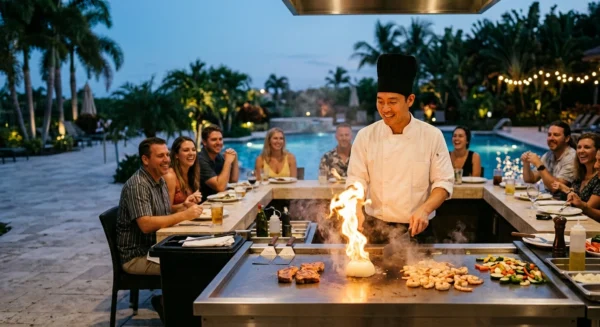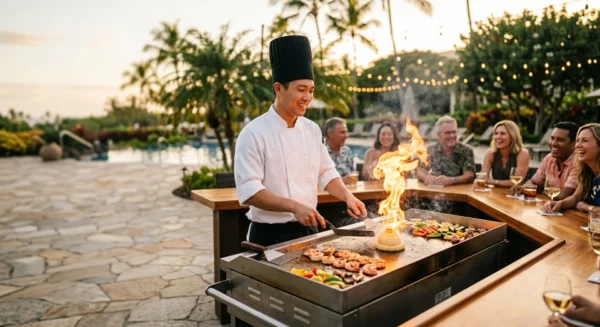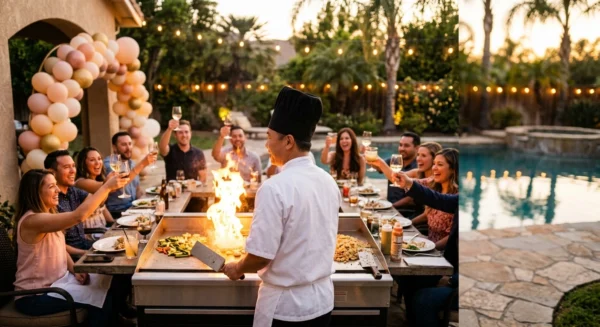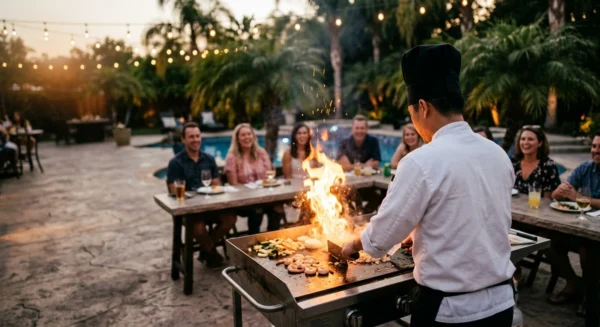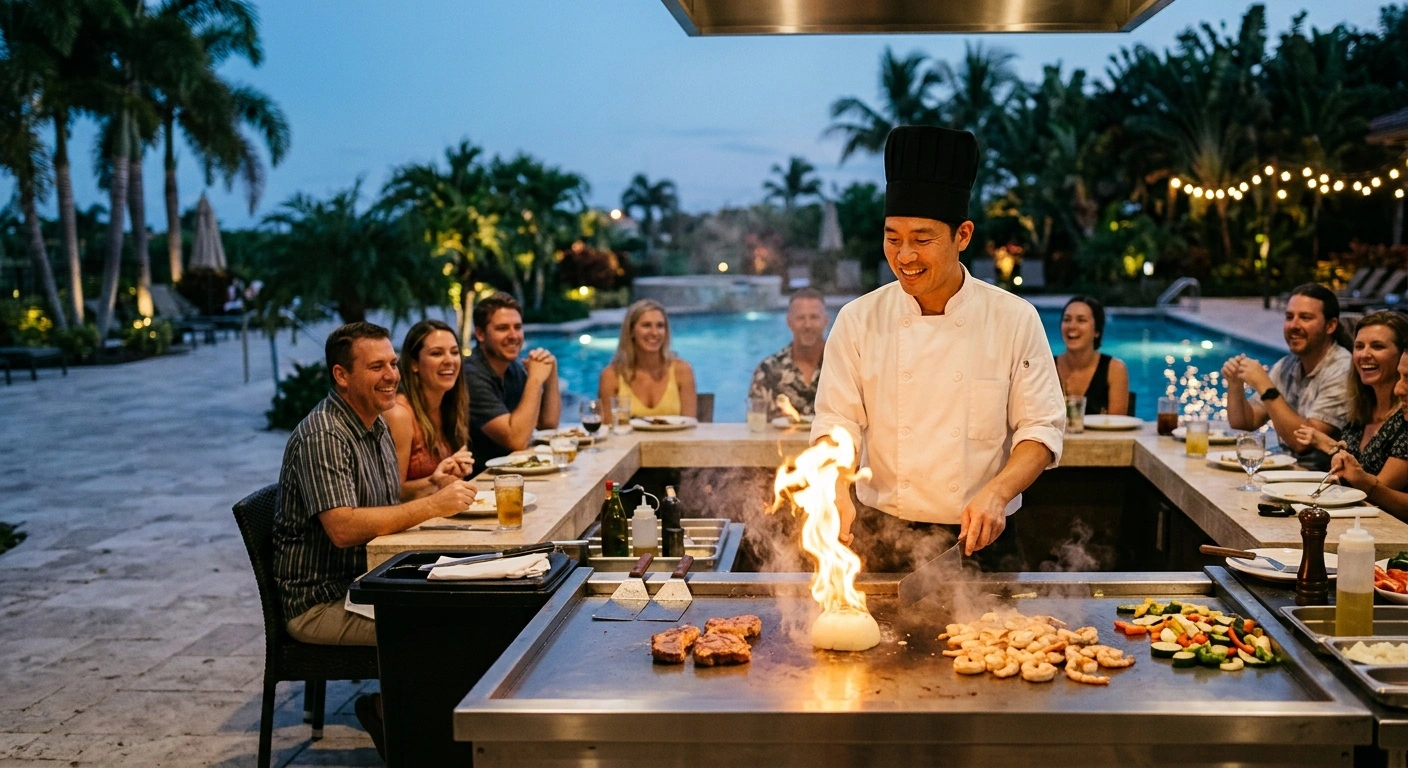
Private chef experiences make sense as soon as the grill heats up and the chef picks up the spatulas. During a hibachi-style dinner, a controlled flame, onion volcano, or shrimp toss can pull the whole table into the show. The cooking becomes part of the party instead of disappearing into a restaurant kitchen.
Guests can ask questions, watch each course come together, and enjoy the meal without competing with a crowded dining room. Meanwhile, the host can sit down instead of checking the oven and clearing plates. The chef can also shape the menu around the occasion and the people attending.
The setting remains private, whether the event is a backyard birthday, a rehearsal dinner at a rental home, or an employee gathering on a patio. Good food, personal attention, convenience, and live entertainment help explain the growing interest in chef-led dining at home.
Why Private Chef Experiences Are Growing Now
No single authoritative figure measures the growth of the entire U.S. at-home private-chef market. Therefore, claims about a precise market growth rate deserve caution. However, several related dining and entertainment trends provide strong signals.
OpenTable reported that U.S. experiential-dining bookings increased 57% year over year during the first half of 2026. The number of restaurants offering bookable experiences rose 26%. Its consumer research also found that 37% of respondents wanted more experiential dining, while 54% would pay more for a one-of-a-kind experience.
Group dining is moving in the same direction. Restaurant reservations for parties of six or more increased 11% in 2025. In addition, 36% of Americans surveyed wanted more group and private dining opportunities in 2026.
National Restaurant Association research found that 52% of consumers would likely attend a private dinner featuring a chef or cuisine expert. Interest exceeded six in ten among Gen Z and millennial adults. The same organization found that 64% of full-service restaurant customers considered the overall experience more important than the meal’s price.
These figures do not directly measure at-home chef bookings. Still, they show demand for the qualities private dining brings together: interaction, customization, group connection, and a meal that feels like an occasion.
People Want Dinner to Be the Activity
Hosts once treated dinner and entertainment as separate parts of the night. They booked catering and then planned music, games, a photo booth, or another activity. A chef-led meal can do both jobs because guests can watch, talk, and participate while they eat.
Watching a chef work creates easy conversation, especially when some guests do not know each other. It gives the group a shared point of interest without forcing anyone into an awkward icebreaker.
Eventbrite research supports that broader social pull. Among people seeking community beyond home, work, and traditional social spaces, 49% wanted to connect through food-and-drink events. Another 39% expressed interest in themed dinners, and attendance at culinary workshops on the platform increased 35% in 2024.
The lesson for hosts is simple. People want dinner, but they also want a reason to gather around it.
Eating at Home No Longer Has to Feel Ordinary
More people are choosing home over a dining room, but they do not want every gathering to resemble a typical weeknight meal. A representative KPMG survey found that 67% of U.S. consumers ate at home more often than they dined out in 2026.
Those eating at home more often cited several reasons. They valued control over ingredients and nutrition, family time, easier access to home entertainment, and simpler accommodation of dietary restrictions. Private dining fits this shift because it preserves the comfort of home while removing much of the work.
Guests do not have to drive to a restaurant, wait for the full party, or leave because another reservation needs the table. Older relatives can use familiar restrooms and seating. Children can take a break without leaving the event.
The host controls the music, lighting, dress code, and pace of the evening. Guests can also move between dinner and conversation more freely. Home becomes the venue, but the meal still feels like an occasion.
Personalization Matters More Than a Long Menu
The strongest private chef experiences focus on the actual guest list, not the number of courses or rarity of the ingredients. A family celebration may need familiar options for children and adventurous choices for adults. It may also require a service time that does not leave grandparents eating at 10 p.m.
A corporate dinner has different priorities. It may need efficient service, clearly identified dietary choices, nonalcoholic drinks, and a format that does not force employees to perform enthusiasm.
During menu planning, separate preferences from medical needs. A guest who dislikes mushrooms presents a different issue from someone with a serious shellfish allergy. Give the food provider a written allergy list before the event.
Ask directly about ingredients, sauces, shared equipment, utensils, frying oil, and cross-contact. Providers should not call a catered meal allergen-free unless their preparation controls support that claim. This advance discussion offers more clarity than ordering several trays and hoping the labels remain attached.
Why Interactive Hibachi Works Especially Well
Hibachi turns cooking into the center of the party. The chef brings a portable flat-top grill, sets it up in a suitable outdoor area, and cooks in front of the group. The service may also include spatula work, familiar tricks, meal service, and the agreed cleanup.
Exact inclusions vary by provider. Hosts should confirm whether the quote covers equipment, tableware, staffing, trash removal, and cleanup. Guests then gather near the grill while chicken, steak, shrimp, vegetables, rice, and similar choices cook in view.
The performance has a natural rhythm. The grill heats, ingredients hit the steel, and the onion volcano goes up. Soon, someone becomes deeply invested in catching a tossed bite.
This format works for birthdays, bachelorette weekends, family reunions, employee appreciation dinners, and casual wedding events. Dinner and entertainment happen at the same time. The host can join the conversation instead of cooking or leaving the kitchen buried in pans.
Hibachi uses an open flame on an outdoor grill. It requires an open, flat outdoor area and advance confirmation of the setup requirements. Do not assume a chef can use the grill indoors, in a garage, on a condo balcony, or beneath a covered area.
Hibachi also commonly involves shared grill surfaces and ingredients such as soy sauce, sesame, butter, egg, and shellfish. Discuss allergies with the chef before booking. Even if the chef omits an ingredient from one plate, the shared grill can create cross-contact.
Private Chef Experiences Compared With Other Dining Formats
A private chef is not the right choice for every event. The decision depends on the guest count, available space, budget priorities, preferred level of interaction, and desired control over the setting.
A restaurant often works well for a small group that wants to arrive, eat, and leave without preparing a home. Buffet catering can make more sense when guests need to eat in waves or the event has a large, flexible headcount.
| Format | Best suited to | Main advantage | What to watch |
|---|---|---|---|
| Private chef | Intimate dinners, milestones, wedding events, and groups that value personal service | Customized meal and direct chef interaction | Kitchen or site requirements, staffing, timing, and cleanup terms |
| Interactive outdoor hibachi | Social celebrations where cooking also serves as entertainment | Live show, freshly cooked meal, and a natural gathering point | Open outdoor space, weather, open-flame rules, and shared-grill allergy concerns |
| Restaurant | Small groups that do not want to host at home | Established dining room, service staff, and no home setup | Noise, travel, reservation limits, fixed seating, and less privacy |
| Buffet catering | Larger groups or events with a flexible meal period | Guests can serve themselves and choose portions | Lines, food-holding temperatures, presentation, and unattended food |
| Food truck | Casual outdoor events with room for vehicle access | Simple ordering and a relaxed atmosphere | Parking, permits, service speed, weather, and guests waiting separately |
A food truck can suit an informal gathering, but vehicle access and ordering lines may divide the group. Chef-led dining usually works better for hosts who prioritize privacy, menu attention, and shared interaction.
Traditional catering often makes more sense when efficiency and volume matter more than performance. Choose the format that solves the event’s practical needs, not simply the one that looks best in photos.
What to Confirm Before Booking
Start with the guest count because nearly every other decision depends on it. Next, choose between a seated dinner, cocktail-style gathering, interactive cooking show, or meal served in waves.
Give the provider the planned serving time, not only the invitation time. A 6 p.m. arrival does not tell the chef whether dinner should begin at 6:15 or 8. Collect dietary restrictions, serious allergies, children’s needs, and mobility concerns before finalizing the menu.
- Menu and service: Confirm courses, portion approach, service format, substitutions, and the timing of each part of the meal.
- What is included: Ask about staffing, cooking equipment, serving pieces, plates, utensils, linens, rentals, setup, trash, and cleanup.
- Site needs: Review refrigerator and freezer space, prep surfaces, sink and handwashing access, electricity, permitted cooking locations, restrooms, and lighting.
- Access: Explain parking, gates, stairs, elevators, loading areas, walking distances, and any restricted delivery times.
- Money: Get a written proposal that identifies the pricing structure, payment schedule, service charges, gratuities, cancellation terms, and possible substitutions.
- Alcohol: Establish who will supply and serve it, what glassware the event needs, and how guests will get home safely.
Do not rely on a friendly phone conversation when a detail affects the budget or service plan. The written agreement should identify who handles rentals, leftovers, and final cleanup.
Check whether the provider already includes gratuity or a service charge before adding a tip. No single tipping rule covers every independent chef and staffing arrangement. Ask for clarification before paying or inviting the group if any important detail remains vague.
Plan Food and Drinks Around the Format
Quantity estimates serve as general rules of thumb, not precise requirements. For an open-house-style event, a broad planning range is 1 to 1.5 pounds of total food per guest. That amount includes proteins, sides, appetizers, and dessert.
One common baseline allows 6 to 8 ounces of protein and 4 to 6 ounces of side dishes per person. However, the chef’s menu, portioning method, guest ages, and event length can change those numbers considerably.
Appetizers before dinner may require only three to four pieces per guest. If appetizers replace dinner, plan a much more substantial amount.
For a one-hour reception, five to six hors d’oeuvre bites per person provides a common starting point. A two-hour cocktail event may call for approximately 10 to 12. If small bites make up the entire meal, guidance can rise to 15 to 20 pieces per person.
Hosts can also serve fewer bites with one or two substantial food stations. For dessert, estimate one cake slice or cupcake per guest, or one to two cookies or bars.
Adjust these ranges for the service style, menu variety, time of day, and alcohol availability. Also consider whether guests will arrive directly from work or another event.
Make water obvious and easy to reach instead of hiding it behind the bar. Give nonalcoholic choices the same attention as cocktails. Options include citrus sparkling water, iced tea with fresh fruit, a ginger-lime cooler, or a zero-proof drink that matches the menu.
If you serve alcohol, do not treat purchase estimates as a target for individual consumption. Encourage safe rides home. For outdoor Florida gatherings, provide extra water and ice.
Food Safety Is Part of Good Hosting
Freshly cooked food is a major appeal of private chef dining. However, appetizers, desserts, cold ingredients, and leftovers still require proper handling.
Do not leave perishable food at room temperature for more than two hours. When the temperature exceeds 90°F, reduce that limit to one hour. Outdoor events in South and Central Florida frequently require the shorter limit.
Keep cold food at 40°F or below and hot food at 140°F or above. Put out smaller serving platters instead of the entire supply. Replace them with freshly chilled or properly hot-held food rather than adding new food to a platter that has sat outside.
Use a food thermometer for cooking instead of relying only on color or appearance. Never reuse raw-meat utensils or platters for cooked food without proper washing and sanitizing.
Refrigerate safe leftovers promptly in shallow containers. Discard food that has exceeded the applicable time limit rather than sending it home with guests.
Florida Weather and Property Rules Can Change the Plan
A clear Florida morning does not guarantee a dry late-afternoon party. South Florida’s wet season brings frequent thunderstorms and lightning. The Orlando area generally experiences its wettest stretch from June through September.
Hurricane season runs from June 1 through November 30. Historically, much of the activity occurs from mid-August through mid-October. Every outdoor event needs a practical backup plan for guests, food, staff, and cooking equipment.
A tent, open pavilion, or covered patio does not provide safe lightning shelter. If anyone hears thunder or sees lightning, everyone should enter an enclosed building or hard-topped vehicle. That rule includes the cook.
Schedule hot-season events toward the evening when possible. Provide shade, water, fans where electrical use is safe, and short periods in direct sun. Keep beverage and perishable-food coolers separate and away from direct sunlight.
Property permission matters as much as the forecast. Condos, HOAs, and vacation rentals may restrict outside vendors, extra guests, grills, open flames, commercial activity, noise, parking, or common-area events.
Get written approval when plans involve equipment delivery, elevators, guest parking, common spaces, or outdoor cooking. Public parks and beaches may require reservations, permits, vendor authorization, insurance, or approval for specific event features.
Those features may include cooking equipment, tents, amplified sound, and alcohol. Check directly with the applicable city or county before booking.
Who Gets the Most Value From a Private Chef
Private dining works best when the meal is central to the gathering rather than a quick stop between activities. It suits hosts who want more time with guests or need a menu shaped around the group. It also fits people who value privacy and interaction more than a large venue.
Milestone birthdays, anniversaries, engagement dinners, rehearsal dinners, family reunions, vacation gatherings, and smaller corporate events all fit that profile. The format can also simplify restaurant logistics for older relatives, young children, or a group staying in one home.
The service offers less value when the property cannot support the setup or the guest count remains highly uncertain. It may also prove impractical when attendees need to eat across a long window. A casual drop-in party may not require this level of service.
Focus on whether the format reduces work for the host and improves how guests spend time together. When it does both, the value extends beyond the food.
A Better Party Starts With a Clear Plan
The rise of private chef experiences reflects a broader preference for meals that feel personal, social, and worth leaving the group chat for. It does not mean every restaurant dinner or catered buffet needs a replacement.
Guests want to connect over food. Hosts want to join them instead of managing burners, serving trays, and cleanup. A chef-led dinner meets both needs when the host plans the menu, site, timing, weather backup, and guest requirements in advance.
For hosts in Miami, Fort Lauderdale, Boca Raton, West Palm Beach, and the Orlando area, Hibachi OMG offers outdoor live cooking with the grill as the gathering point. Setup requirements, menu details, availability, and pricing vary. Request a quote and confirm the property rules before making plans.
The right choice may be hibachi, another private-chef format, a restaurant, or traditional catering. Choose the option that keeps the group connected and the host out of the kitchen.