Choosing a private chef for events starts with three checks. The chef needs relevant experience, a suitable service model, and a detailed written agreement. Before paying a deposit, confirm who will cook, where preparation happens, and how the team handles allergies. Also verify pricing, cleanup duties, equipment needs, and weather plans.
A polished social feed shows style, but it does not prove reliability. Photos cannot confirm punctuality, portion accuracy, or proper food-holding equipment. A chef suited to a 10-person anniversary dinner may struggle with a 40-person company party.
Start with your party format, then compare chefs against that specific job. The goal goes beyond impressive food. You need a service plan that works with your property, guests, and schedule.
Decide What Kind of Chef Service You Need
“Private chef” can describe several event formats, so define the experience before requesting proposals. Plated dinners require different kitchens, staffing, and timelines than buffets or passed appetizers. Live cooking brings its own space, fuel, safety, and weather requirements.
Tell each chef whether food will anchor the event or support a larger celebration. Include the guest count, age range, event address, meal time, and property type. The setting could be a home, rental, office, clubhouse, park, or private venue.
Explain how formal you want the service to feel. Birthday guests may enjoy talking with the chef during an interactive dinner. A wedding-related meal may need quiet service, coordinated courses, and a firm time for toasts.
For corporate gatherings, choose a format that does not force participation. Mention outdoor settings immediately. Weather protection, lighting, transport, food holding, and cooking permissions can change the entire plan.
| Service format | Best suited to | Questions to ask |
|---|---|---|
| Plated dinner | Anniversaries, small weddings, and formal dinner parties | How many courses and servers will you provide? What kitchen equipment do you require? |
| Family-style meal | Reunions, rehearsal dinners, and relaxed milestone parties | Do you provide serving pieces? How will you replenish hot food? |
| Buffet | Larger mixed-age groups and flexible schedules | Who monitors temperatures, replaces platters, and clears used dishes? |
| Passed appetizers | Engagement parties, cocktail events, and client gatherings | How many pieces will each guest receive? Will they replace a full meal? |
| Live cooking | Birthdays, backyard parties, team dinners, and entertainment-centered celebrations | What space, fuel, equipment, seating, weather backup, and property approval do you require? |
How to Vet a Private Chef for Events
Ask every candidate the same core questions. This approach lets you compare clear answers instead of personalities. First, confirm who will attend because the menu designer may not cook at your party.
Ask about chefs, assistants, servers, bartenders, and cleanup staff. Find out whether you must approve staffing substitutions. For larger events, identify the onsite lead and the host’s contact for schedule changes.
Relevant experience should match your guest count and service style. Request references or examples from comparable events. Then ask about punctuality, communication, portions, cleanup, equipment failures, and weather problems.
Photos help you assess presentation, but they cannot reveal whether dinner ran an hour late. A prepared chef can explain the event from arrival through departure. Vague answers should concern you.
- Who will cook? Get the assigned chef’s name or role and clarify the substitution policy.
- Which staff members will attend? Confirm chefs, assistants, servers, bartenders, and cleanup workers.
- Where will preparation happen? Separate onsite work from food prepared, stored, or transported elsewhere.
- What equipment does the menu require? Discuss ovens, burners, refrigeration, sinks, counters, electrical circuits, lighting, and outdoor equipment.
- How will the team handle disruptions? Ask about delays, equipment failure, severe weather, and chef illness.
- Does the business carry insurance? Request proof of commercial general liability insurance when appropriate.
- Who handles alcohol? Clarify licensing, property approval, staffing, and applicable insurance when the provider supplies or serves it.
Ask How the Chef Purchases, Prepares, and Transports Food
In Florida, “Are you licensed?” does not provide enough information. Different service models may face different regulatory requirements. The answer depends partly on where the chef stores, prepares, and serves the food.
A chef who works entirely onsite for a private household or party may follow one regulatory model. Caterers who prepare or store food elsewhere generally use an approved, licensed food-service establishment. They do not typically use a private residence for offsite storage and preparation.
A licensed restaurant may provide catering through its existing public food-service operation. Ask the provider to explain the full chain. Cover purchasing, storage, advance preparation, transportation, service, and leftovers.
If the company uses a Florida food-service license, request its legal business name and applicable license number. You can verify that information through the state’s official licensing portal. Available inspection records may also provide useful context.
However, an inspection captures one point in time rather than a permanent grade. Review the disposition, repeated patterns, and required follow-up. Avoid judging the business from one number without context.
A polished booking profile does not explain the provider’s legal or food-safety structure. Direct questions can uncover unclear arrangements. These may include preparation in an unapproved home kitchen or work by an undisclosed subcontractor.
Do not assume rules for public festivals apply identically to invitation-only private meals. Ask the chef which service model applies to your event. The provider should give a clear explanation.
Build the Menu Around Your Guest List
Send an accurate count of adults, teenagers, and young children. Include the event start time and planned meal time. Teenagers, long parties, and self-service buffets may require larger quantities than short seated dinners.
Collect dietary information during the RSVP process. Ask about allergies, religious restrictions, medically required diets, and vegetarian or vegan preferences. Also identify mobility accommodations before finalizing the layout.
Guests should not need to announce medical or religious details at the table. Share necessary information privately with the chef. Make sure servers also understand the final plan.
For allergies, ask about specific ingredients and cross-contact procedures. Do not accept a broad promise that a menu is “safe.” Major food allergens include milk, eggs, fish, crustacean shellfish, tree nuts, peanuts, wheat, soybeans, and sesame.
Separate utensils, cutting boards, preparation areas, and serving pieces may reduce cross-contact. Still, a provider should not promise an allergen-free meal without supporting that claim. Communicate recipe substitutions because packaged labels do not answer every onsite preparation question.
Quantity estimates offer planning guidance rather than guarantees. A substantial menu may total roughly 1 to 1.5 pounds of food per guest. That total includes proteins, sides, appetizers, and dessert.
Another starting point uses 6 to 8 ounces of protein and 4 to 6 ounces of sides. Add one standard dessert serving per person. The chef should adjust quantities for the menu, guests, service length, and event focus.
| Event food format | General planning rule of thumb |
|---|---|
| Appetizers before a separate dinner | About 3 to 4 bites per guest |
| One-hour reception | About 5 to 6 bites per guest |
| Two-hour cocktail event | About 10 to 12 bites per guest |
| Appetizers replacing dinner | About 15 to 20 bites per guest |
| Substantial mixed menu | Roughly 1 to 1.5 pounds of total food per guest |
Read the Proposal Line by Line
A useful proposal should leave little to memory. It should list the date, address, guest count, arrival time, service window, menu, and portion basis. It should also cover staffing, rentals, setup, cleanup, and host responsibilities.
“Dinner for 20” does not provide enough detail. One chef may mean a plated three-course meal. Another may mean food placed on a self-service buffet.
Check everything included beyond the food. Review groceries, ice, water, garnishes, plates, glassware, flatware, linens, and serving pieces. Do the same for tables, chairs, chafing equipment, disposable goods, and trash removal.
The chef may include these items, offer them as extras, or assign them to the host. Ask who will package leftovers and provide containers. Also determine when the chef’s food-safety responsibility ends.
If you must refrigerate leftovers, clear enough refrigerator space before service ends. Do not wait until cleanup begins. Proper planning keeps food from sitting out while guests rearrange shelves.
The proposal should separate food, labor, travel, delivery, rentals, taxes, and administrative or service charges. It should also identify overtime and added-guest costs. Compare complete totals instead of headline prices.
Do not assume the staff receives a service charge as gratuity. Ask how the business handles it. Tipping customs vary, so read the contract before adding a gratuity.
Review the deposit, payment schedule, and final-headcount deadline. Check menu-change, cancellation, postponement, and refund terms. The agreement should also address the assigned chef’s unavailability.
- Final guest count and the policy for late additions
- Exact service start and finish times
- Menu substitutions and ingredient availability
- Staffing details and substitution approval
- Overtime terms
- Rental delivery and pickup duties
- Damage, breakage, and trash-removal terms
- Cancellation, postponement, and refund conditions
- Weather decisions and unsafe-condition policies
Inspect the Property Before Booking
A chef cannot plan around an unknown kitchen or patio. Confirm oven capacity, burners, refrigeration, freezer space, sinks, counters, and electrical circuits. Check ventilation, water access, and nighttime lighting as well.
A large vacation-rental kitchen may still have limited cookware or a small refrigerator. The property may also restrict outside vendors. Photos and a short video walkthrough can prevent surprises.
Some events justify an in-person site visit. Ask the chef based on the menu and setup. Live cooking and complex rentals often require closer review.
Map the load-in route as carefully as the cooking space. Condominiums may require vendor registration, insurance certificates, elevator reservations, and loading-area approval. Security access and surface protection may also affect setup.
HOA or condo approval for a residence does not cover every shared space. Clubhouses, pool decks, guest parking, and other common areas may need separate permission. Written management approval may carry more weight than verbal permission from a concierge or board member.
For an Orlando vacation rental, get written permission from the owner or manager. Cover the chef, outside guests, deliveries, cooking equipment, and alcohol service. Review occupancy, noise, parking, trash, pool, and event rules.
A large house does not automatically allow a large party. Public parks and beaches may require reservations or event permits. They may also require vendor approval, food-service documentation, or insurance.
Grills, tents, generators, music, and alcohol can require separate permission. Contact the managing city or county before booking grill-based or catered service. Confirm the rules in writing when possible.
Make Food Safety Part of the Interview
Food safety can become urgent quickly in Florida heat. Ask how the chef will keep cold food at 40°F or colder. Hot food should remain at 140°F or warmer during transport, setup, and service.
The team needs enough coolers, ice, insulated carriers, and hot-holding equipment. It also needs calibrated food thermometers. “Keeping it warm” does not describe a safe holding plan.
Perishable food should generally stay at room temperature for no more than two hours. That window drops to one hour when the air temperature exceeds 90°F. Outdoor service requires extra attention.
Use smaller backup platters instead of displaying the entire food supply. Replace used serving dishes with clean, freshly filled ones. Do not add fresh food to platters that guests have already handled.
Keep cold dishes on ice and hot foods properly heated. Protect displayed food from insects, dust, windblown debris, and unnecessary contact. Assign someone to monitor the setup throughout service.
Ask about handwashing, clean utensils, and sanitized food-contact surfaces. Discuss raw-food separation, water handling, wastewater handling, and sick-worker policies. A professional should answer these questions directly.
Food safety forms part of hospitality. A chef should not dismiss temperature control or cross-contact concerns. Keep looking if a candidate avoids specific answers.
Plan for Florida Heat, Rain, and Lightning
Outdoor chef service needs a practical weather plan. South Florida and Central Florida often experience heat, humidity, and afternoon thunderstorms during the warmer wet season. Seasonal patterns help planning, but they cannot replace the event-day forecast.
Hurricane season runs from June through November. Contracts during those months should cover tropical watches, warnings, unsafe travel, evacuations, postponements, and refunds. Review those terms before paying a deposit.
Schedule summer meals during the evening when possible. Provide shade, fans, and plenty of cold water for guests and staff. Decide who will monitor radar and pause service.
If anyone hears thunder, move everyone to a substantial building or another appropriate safe shelter. That instruction includes the cook. A decorative canopy does not provide safe lightning protection.
Wait at least 30 minutes after the last thunder before resuming outdoor activity. The contract should name the person who decides when conditions become unsafe. It should also set deadlines for moving, postponing, or canceling.
A rain plan must accommodate guests, food, staff, and equipment. Crowding everyone indoors does not automatically solve the service problem. Plan the revised layout before event day.
Never assume you can move an open-flame grill into a garage or indoors. Low covered areas can also create hazards. Confirm a flat, open outdoor setup and a separate weather alternative.
When At-Home Hibachi Fits the Event
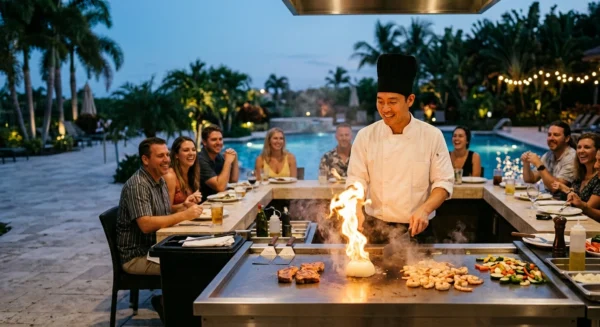
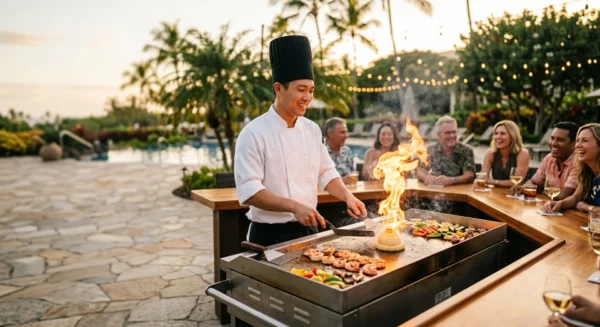
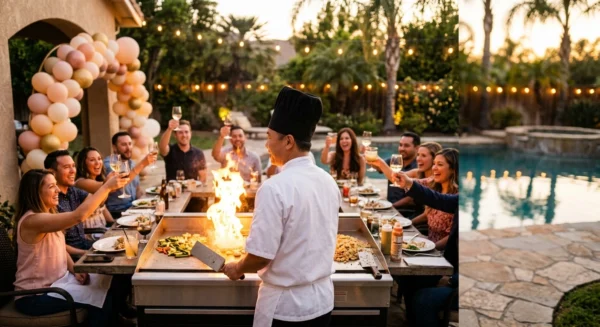
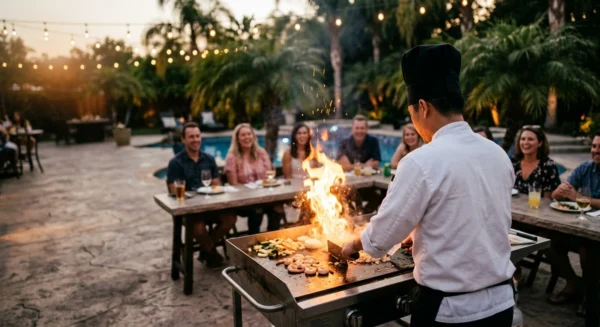
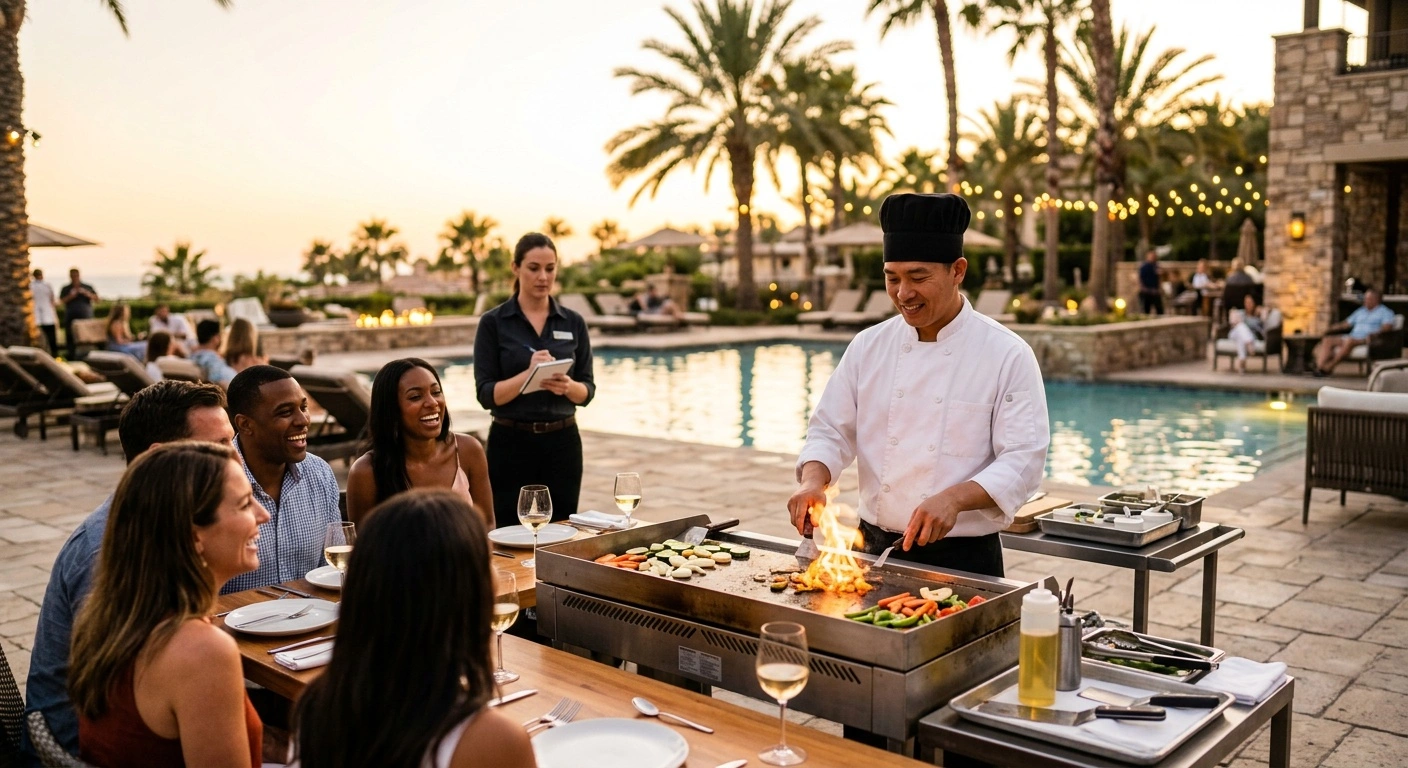
At-home hibachi combines dinner with live entertainment. Guests gather around a flat-top grill and watch the chef cook. The experience may include spatula work, tossed shrimp, an onion volcano, and controlled flames.
This shared focus can suit birthdays, reunions, and team dinners. The host does not need to arrange separate entertainment after the meal. The format also keeps the host away from the stove.
Hibachi still requires careful screening and planning. Chefs often use shared grill surfaces and ingredients such as soy sauce, sesame, butter, egg, and shellfish. Discuss allergies and cross-contact well before the event.
Confirm protein selections, meal timing, and seating around the grill. Make sure older guests and people with mobility needs can reach their places. Do not promise anyone an allergen-free meal.
A portable hibachi grill uses an outdoor open flame. It needs a flat area away from structures, decorations, and guest traffic. Check HOA, condominium, rental, venue, park, and local rules before booking.
You also need an indoor safe location during lightning. However, the grill cannot move indoors with the guests. Confirm both plans before event day.
Hibachi OMG serves as one quote option in South Florida and the Orlando area. Confirm setup requirements, menu details, availability, and event terms directly with the business.
Use a Booking Timeline That Leaves Room for Changes
Good chefs need clear information before they can prepare a useful proposal. Do not begin with price alone. Send the same event summary to each candidate and compare equivalent services.
A low initial figure may increase after staffing, rentals, travel, cleanup, and service charges. More importantly, the service must fit the property. A mismatched plan offers little value at any price.
The following timeline provides general planning guidance. Larger weddings, holiday events, corporate parties, and permitted gatherings may need more lead time. Keep approvals, contract revisions, and menu updates in writing.
One week before the party, every major detail should be settled. Confirm where the chef will park, enter, cook, serve, and dispose of trash. Last-minute uncertainty creates avoidable delays.
| When | What to do |
|---|---|
| Several weeks or more before | Define the format, budget framework, guest range, address, meal time, and service style. Check property rules before requesting grill-based service. |
| Before paying a deposit | Verify the business identity, licensing model, insurance, assigned staff, menu, equipment needs, cancellation terms, and weather policy. |
| Two to three weeks before | Collect RSVP details, dietary restrictions, allergies, accessibility needs, and accurate counts of adults and children. |
| By the contract deadline | Submit the final headcount, approve menu changes, confirm rentals, and make required payments. |
| One week before | Confirm load-in, parking, elevators, power, water, refrigeration, lighting, trash, alcohol arrangements, and the weather backup. |
| One to two days before | Clear refrigerator and counter space, prepare the service area, review the forecast, and send arrival instructions. |
| Event day | Keep access routes open, identify the host contact, secure pets, monitor weather, and avoid last-minute layout changes. |
Choose the Chef Whose Plan You Trust
The right private chef for events makes the evening sound simpler as planning becomes more detailed. You should know who will arrive, what they will bring, and where preparation will happen. The plan should also cover service timing, dietary needs, weather, and equipment problems.
Compare complete proposals rather than headline prices. Pay close attention to communication before booking. Missed deadlines and avoided questions often reveal how the chef may handle event day.
Put the final menu, staffing, property requirements, charges, cleanup, and contingency terms in writing. Then you can focus on your guests. You should not spend the party searching for ice, extension cords, serving spoons, or a rain plan.